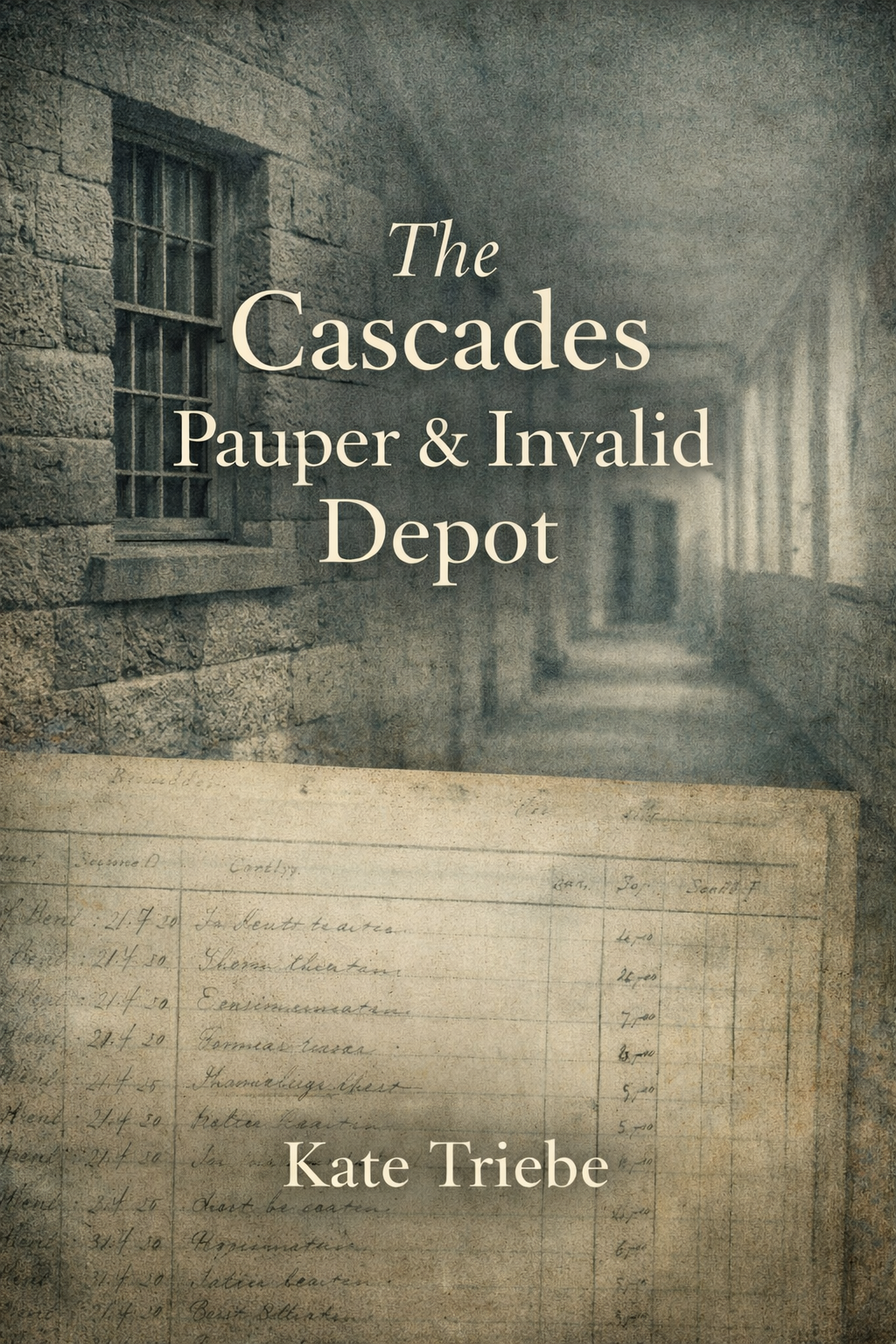
The Cascades Pauper & Invalid Depot is a work of historical fiction grounded in archival record and lived experience. Set in nineteenth century Tasmania, the novel follows Margaret, a clerk within the Cascades Pauper and Invalid Depot, whose role is to observe, record, and categorise the women confined there. The institution presents itself as charitable and corrective, yet its routines quietly erode identity, agency, and memory.
As Margaret documents admissions, transfers, and deaths, she becomes increasingly aware of what the records omit. Women vanish not only through illness and removal, but through administrative silence. Small acts of compliance are rewarded. Deviations are noted, corrected, and erased. The novel traces Margaret’s gradual moral contamination as she learns that to record suffering is not the same as resisting it, and that accuracy itself can become a form of complicity.
Moving from Cascades to Brickfields Asylum, the narrative charts the evolution of institutional control from punishment to medicalisation, revealing how systems adapt while maintaining the same underlying logic. Through restrained prose and carefully realised scenes, the book explores how power operates through routine, classification, and habit rather than spectacle.
Written to stand alongside The Female Factory Tragedy, this novel completes a continuum of Tasmanian institutional history, examining what followed when overt punishment gave way to quieter forms of containment. Together, the books ask what it means to remember ethically, and who bears the cost of preservation.
Steeped in archival detail, The Cascades Pauper & Invalid Depot stands both within and apart from history. Here, silence is temptation. Habit is survival. And deviations from the record echo loudest in their absence.
The Cascades Pauper & Invalid Depot is a work of historical fiction grounded in archival record and lived experience. Set in nineteenth century Tasmania, the novel follows Margaret, a clerk within the Cascades Pauper and Invalid Depot, whose role is to observe, record, and categorise the women confined there. The institution presents itself as charitable and corrective, yet its routines quietly erode identity, agency, and memory.
As Margaret documents admissions, transfers, and deaths, she becomes increasingly aware of what the records omit. Women vanish not only through illness and removal, but through administrative silence. Small acts of compliance are rewarded. Deviations are noted, corrected, and erased. The novel traces Margaret’s gradual moral contamination as she learns that to record suffering is not the same as resisting it, and that accuracy itself can become a form of complicity.
Moving from Cascades to Brickfields Asylum, the narrative charts the evolution of institutional control from punishment to medicalisation, revealing how systems adapt while maintaining the same underlying logic. Through restrained prose and carefully realised scenes, the book explores how power operates through routine, classification, and habit rather than spectacle.
Written to stand alongside The Female Factory Tragedy, this novel completes a continuum of Tasmanian institutional history, examining what followed when overt punishment gave way to quieter forms of containment. Together, the books ask what it means to remember ethically, and who bears the cost of preservation.
Steeped in archival detail, The Cascades Pauper & Invalid Depot stands both within and apart from history. Here, silence is temptation. Habit is survival. And deviations from the record echo loudest in their absence.