

 Image 1 of 5
 Image 2 of 5
 Image 3 of 5
 Image 4 of 5
 Image 5 of 5
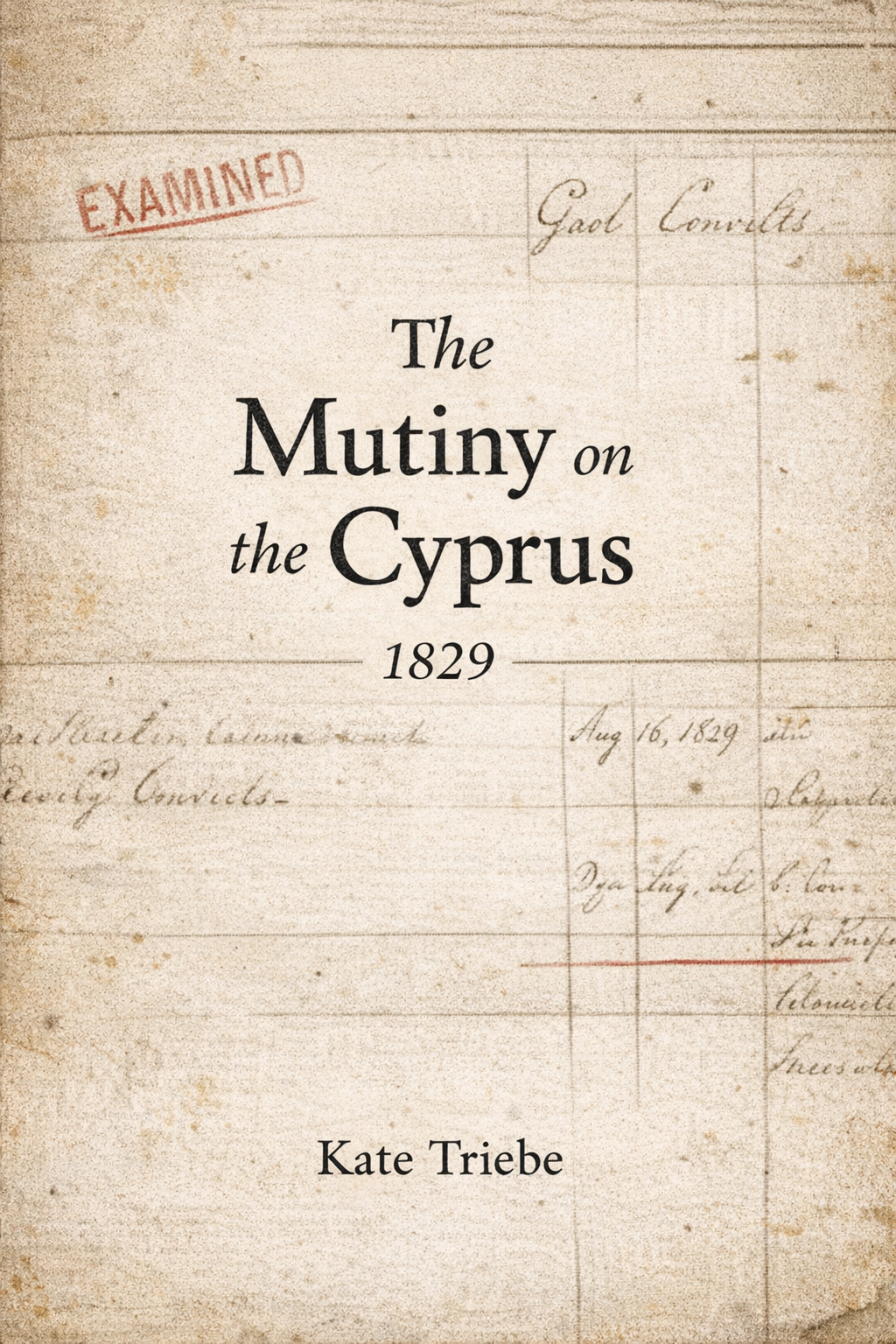
In August 1829, convicts seized the government brig Cyprus while anchored in a remote bay of Van Diemen’s Land and carried the vessel thousands of miles across the Pacific. The mutiny is often recalled as a maritime curiosity. This novel approaches it differently.
The Mutiny on the Cyprus (1829) is a rigorously grounded work of historical fiction that reconstructs the event from within the daily labour of a small brig and the institutional systems that governed nineteenth-century seafaring. Told in the first person by a fictional yet historically plausible participant, the novel traces not only the seizure of the vessel but the long consequences that followed: navigation under coercion, fragile authority at sea, encounters with unfamiliar shores, and the eventual reassertion of Admiralty law.
Rather than romanticising piracy or rebellion, the book focuses on process. It examines how ships function as regulated spaces, how command is asserted and contested aboard working vessels, and how maritime order extends beyond the horizon through legal and bureaucratic systems. Particular attention is paid to seamanship, navigation, provisioning, and the material realities of long Pacific voyages, as well as to the treatment of the Cyprus as an object subject to ownership, seizure, and legal interpretation.
The novel concludes with the return of the surviving mutineers to British jurisdiction and the Admiralty trials that followed, situating the voyage within the wider framework of maritime law and imperial governance. Grounded in archival research and written with deliberate restraint, The Mutiny on the Cyprus (1829) offers a maritime narrative concerned less with adventure than with consequence, record, and erasure.
In August 1829, convicts seized the government brig Cyprus while anchored in a remote bay of Van Diemen’s Land and carried the vessel thousands of miles across the Pacific. The mutiny is often recalled as a maritime curiosity. This novel approaches it differently.
The Mutiny on the Cyprus (1829) is a rigorously grounded work of historical fiction that reconstructs the event from within the daily labour of a small brig and the institutional systems that governed nineteenth-century seafaring. Told in the first person by a fictional yet historically plausible participant, the novel traces not only the seizure of the vessel but the long consequences that followed: navigation under coercion, fragile authority at sea, encounters with unfamiliar shores, and the eventual reassertion of Admiralty law.
Rather than romanticising piracy or rebellion, the book focuses on process. It examines how ships function as regulated spaces, how command is asserted and contested aboard working vessels, and how maritime order extends beyond the horizon through legal and bureaucratic systems. Particular attention is paid to seamanship, navigation, provisioning, and the material realities of long Pacific voyages, as well as to the treatment of the Cyprus as an object subject to ownership, seizure, and legal interpretation.
The novel concludes with the return of the surviving mutineers to British jurisdiction and the Admiralty trials that followed, situating the voyage within the wider framework of maritime law and imperial governance. Grounded in archival research and written with deliberate restraint, The Mutiny on the Cyprus (1829) offers a maritime narrative concerned less with adventure than with consequence, record, and erasure.